For years, we’ve been told that marketing is a math problem. If you put enough people into the top of a “funnel” through lead magnets and drip campaigns, a predictable percentage will eventually come out the bottom as customers. We obsessed over pillar content and subpages designed to keep people trapped on our sites for as long as possible.
But while we were staring at Google Analytics dashboards (because GA4 made all of us spend way too much time in it 🙃), the game fundamentally changed. Today, 58.5% of Google searches are “zero-click.” People aren’t clicking your links; they are reading the AI overview and moving on with their lives. If your website’s primary value is providing generic information, you’ve become a commodity that AI can summarize in seconds.
AI can summarize facts, but it cannot synthesize experience. To survive this shift, your website has to stop being a “Wiki” and start being a uniquely designed experience that proves you are exactly who you say you are. But, the thing is, this isn’t just a website problem. It all boils down to how your business shows up online across multiple platforms and is actually memorable.
The “Savannah Bananas” Standard
When someone finally clicks through to your site from LinkedIn or a podcast, I want the first thought in their head to be: “Yep. This is exactly (or better than) what I expected”.
Think about Jesse Cole and the Savannah Bananas. They put out 10-out-of-10 value on YouTube and TikTok every single day. You see the energy, the crazy trick plays, and the fans having the time of their lives. You see the sea of people waiting multiple hours to get into the park (and enjoying the waiting process). You watch the live band play hours after the game is actually over (and, on top of that, a large crowd is still hanging out with the players). If you see videos of Jesse, you hear his broken-record soundbite: “Everything we do is Fans’ First.”
By showing up in this way, they are setting the bar so stinkin’ high that in order for a fan to say “this is exactly what I expected,” they have to deliver a life-changing experience, at scale, for every fan in the stadium.
But… what about B2B?
In the entertainment world, value is defined as moments that are “remarkable or unforgettable.” (Heck, they may not even need to be memorable — how many reels have you sent to your friends and forgot about 45 seconds later? Just saying…).
In B2B, value is often seen as “helpful or actionable.” If the Bananas use trick plays to set their bar, what is the B2B equivalent? Is it giving away your best strategy for free on the homepage, or is it a specific tool that provides a “mic drop” level of clarity before a call even happens?
But then, as business leaders, we’re also challenged to not “give away” the strategy… so it feels counterintuitive to write up the secret sauce on the homepage, for free, and not behind a form that requires a user to at least give an email address in exchange for this “$999 of value.”
Three pillars of authenticity
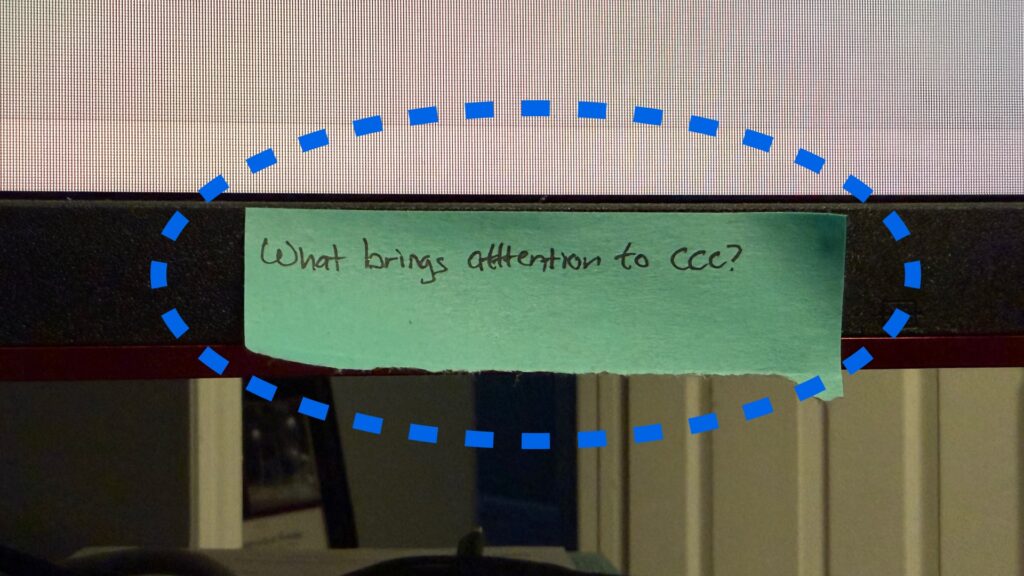
Yes, it’s going to be a challenge to figure out how to make your B2B business stand out on TikTok by doing funny dances. I have had a sticky note on one of my monitors for two years as a constant reminder to think: “What brings attention to CCC?” The thing is, it’s not as simple as getting some of my agency buddies together and doing ridiculous things on camera.
The Bananas (and other consumer products) have a much stronger likelihood of standing out by simply “being silly” online.
The thing is, their target market is larger than mine (and probably yours, too). I run a B2B business with a limited number of potential buyers (also, don’t they say that only 5% of your target market is in a “buy now” phase? We live in a world that doesn’t benefit from consumer “impulse buying”).
The Bananas want the whole family to come to a game, while your/my target market is CMOs of tech companies (or something similar).
Let’s just say you were able to go viral on TikTok, creating a video that successfully connected “fun times” and “your business’s offerings” together. Chances are, the “doom-scrolling CMO” isn’t in the mindset to purchase your service right at this very minute. They are probably in a mode of turning off their work-brain.
So, how the heck do we (as business leaders) be authentic?
Message
How do you talk in sales conversations? How do you collaborate when you’re working on a project with a client? That’s how I want you to show up across the board.
Personally speaking, I’m not a huge fan of RFPs and presenting in front of teams of ten decision makers. I enjoy the 1:1 nature of the sales process and being able to get into the trenches with those folks to showcase value. I like giving away too many ideas, showing people what the final product could look like ahead of time, and having a conversation versus a presentation.
When I work with clients, I always try to have them lean towards content that would feel like something that they themselves would actually say. If you’re wordy, feel free to use a few too many words. If you joke around, have some humorous anecdotes in the stories that you tell in your writing. Do you tell too many dad jokes? Sprinkle some of those in there as well.
The goal is to reduce the amount of shock or surprise. You know those rare times where you get to meet someone in person who you’ve followed along their journey for years and years? You feel like you know them oh-so-well and think they are simply the best people ever? Then… you meet them. One of two thoughts go through your head when you leave the interaction:
- “Oh my word! They were exactly who I expected them to be!!!”
- “Wow. They suck in real life.”
Whatever content you’re creating (website, video, or audio), I want you to lean more into who you are as a person so that when people do meet you, their thoughts are more in-line with Option 1 than Option 2.
Consistency
Over time, being consistent in the market has become more and more complex:
- Originally, you just had to have a good logo and a similar experience in your office
- When print ads came around, your logo, ad design, and office had to match one another
- Then, digital ads (both static and video) came around, and added this complexity into the mix
- Websites soon became a requirement (and those are multifaceted)
- Then came social media (not just crafting a single profile, but multiple posts… per week)
- Short-form (vertical!) video exponentially grew
- And now, personal brands are (and have been) a much larger selling point
Through all of this growth, our message and aesthetic have to remain consistent over so many new mediums. And at the same time, the number of tools that can handle much of this on our behalf has thankfully increased at a similar pace. Because of this, it’s simple to be active across a number of different mediums, but, if you want to stand out, a lot of those automated tools don’t help. Those tools are great to “rinse and repeat” the same style and structure everyone else outputs. But, if you want to do something unique to yourself, streamlining that typically takes some technical expertise.
So, how do we do it?
It’s all about the shtick

What separates a high-end, high-competence aesthetic from a poor one? It’s all in the schtick.
Generic, “out-of-the-box” designs all follow the same tropes: identical two-column layouts, standard header sections, and predictable navigation. This can be said about other marketing designs too (social media posts, vertical video reels with captions, etc…). A unique design pulls design “flares” directly from the brand’s personality and logo. It creates a visual aesthetic that could only be made by someone who really understood what the brand was all about.
The thing is, it doesn’t have to be super-custom. It doesn’t have to be complex. At the time of writing, the Classic City shtick is:
- Rounded edges
- Solid drop shadows
- Consistent header fonts and body copy fonts
- Five colors (used very specifically)
- Dashed lines
- Light gray backgrounds (so “white” sections stand out)
But, whether you see content: (a) on the website, (b) on a proposal, (c) on our company’s LinkedIn, (d) my personal LinkedIn, or (e) my podcast, it all feels the same. Sure, as a creative, it’s really, really boring. I want to change it up regularly. But, when your aesthetic is consistent, it reduces the shock factor when someone is ready to make a purchasing decision.
Transparency
I’m a huge fan of making a website sound like it’s coming from the mouth of a human and not a corporate entity.
On my Classic City site, I took this up a few notches recently. My homepage is essentially a long-form letter from me answering every a lot of questions I’ve been asked. My goal was to take our standard proposal and the most common questions I get during a sales call, and shove them all on the homepage. You get to see our actual team photos, our process, and our FAQs. Most importantly, you see our pricing ranges.
In the web industry, most people hide behind a curtain and force you to schedule a “discovery call” just to understand if you can even afford them. I’d rather flip the script. Is it risky to put it all out there? Sure. People might make a judgment and move on before we even talk. But I’d rather go the honest and transparent route because it reduces the “surprise factor” and builds an emotional connection before the first Zoom call even starts.
Because of the norms in my industry, this level of transparency helps me stand out. However, since I decided to be super-transparent on our website, the rest of my marketing efforts need to match that same tone. Whether it’s through the emails I send out on a regular basis, or the posts I make on LinkedIn, it needs to connect back to that transparent tone I’ve created for myself. But, the thing is, that’s easy for me because it is me. I just simply get to be myself online.
What is your version of this?
Your website is the validation engine
The thing is, all of this external effort to get all these things right boils down to a single thing: your website. Sure, I’m biased, as I build websites for a living.
But, your website is no longer a “discovery” tool — it is a validation engine. Most of your leads will find you on other platforms first (as they should), you will then build trust on that other platform, and when they finally think: “OK, I may want to give this person money,” now your website has to live up to all the hype. With that being said, by the time they land on your homepage, they aren’t looking for basic information; they are looking for a reason to trust you.
The question then becomes: does your website accelerate that stranger’s trust or decelerate it?